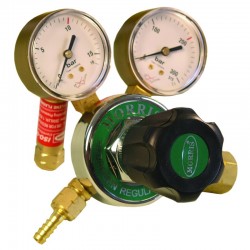

Instructions for handling reducer valves for bottles
Instructions for reducer valves for bottles with pressure control according to EN ISO 2503
These instructions are intended to ensure safe handling of pressure control valves in accordance with current regulations. A detailed reading of this instruction will help you avoid risks and loss in production, as well as improve the reliability and durability of the reducer valve.
p>These instructions must be kept permanently on hand in every workshop./p>= for Safety Instructions see also paragraph 2;/strong>
if in doubt, contact the manufacturer.trong>
1. Operation
- Use in accordance with applicable regulationsi>
- Reducer valves are intended for use with compressed gases or dissolved gases under pressure in filling cylinders max. 300 bar, also for liquid gases, and pressure reduction in the corresponding cylinder, as well as to ensure constant working pressure.>
- Reducer valves can only be used for those gases that are mentioned on the valve label (see labels, paragraph 3).
- Use in accordance with applicable regulations
- Reducer valves must not be for gases in a liquid state
- Reducer valves must not work in ambient temperatures below -30°C or above +60°C
- Reducer valves must not be used for corrosive gases, such as ethylamine, dimethylamine, ammonia, etc./li>
2. Instructionabout safety
- All indications are that safety instructions are important./li>
- Reducer valves are made in accordance with current relevant technical regulations and meet all existing standards.i>
- Changes or alternations on the reducer valve must not be made without the approval of the manufacturer.
- No additional connections are allowed between the reducer valve and the pressure control valve./li>
- Improper use and use contrary to its intended purpose can endanger the operator and other persons, and cause damage to the reducer valve and installation.
- The regulations must be respected:br />In Germany: UVV (= instructions for avoiding welding and cutting accidents and VGB 15), EN ISO 2503 Reducer valves for bottles.
3. Labels
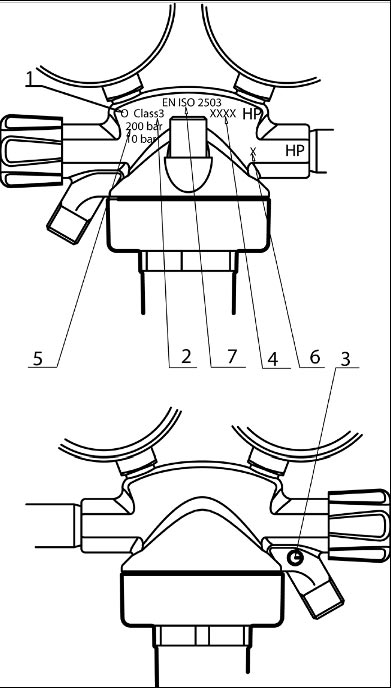
1 gas
2 class valve corresponds to EN ISO 2503
3 manufacturer distinguishing mark
4 production data code
5 max. inlet pressure 0 (only for oxygen and other compressed gases)/p>
6 proof of inspection
7 E EN ISO 2503
4. Commissioning/strong>
- Danger of explosion! Keep all parts, your hands and tools in contact with oxygen free of oil and grease.
- these instructions for use must be conscientiously and thoroughly studied before starting work, and followed in detail during work.i>
- Check if the reducer valveis suitable for the gas to be used (see Mark-ma, paragraph 3)./li>
- Check that the cylinder valve is clean and undamaged, if not, the reducer valve must not be connected.i>
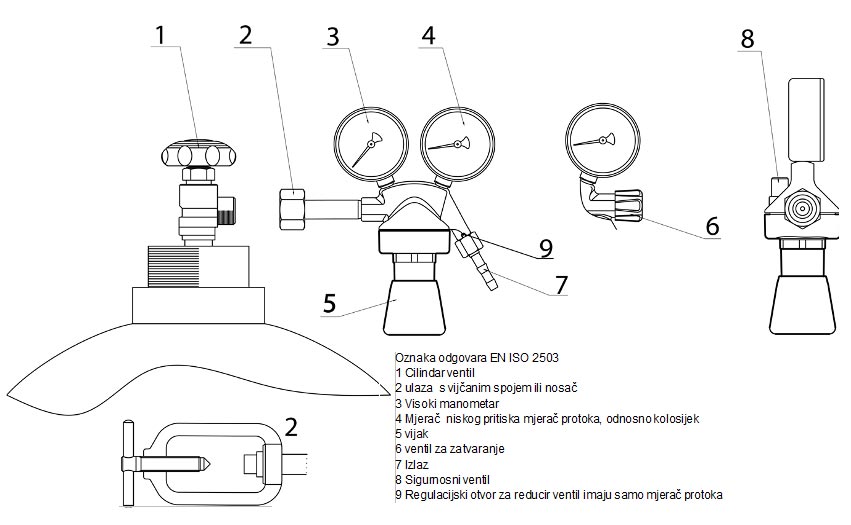
- Before connecting the reducer valve, open and close the cylinder valve (1) to remove possible impurities. Do not stand in front of the cylinder valve. Do not hold your hand in front of the valve cylinder
- Connect the reducer valve hermetically using the nut for the hose connector (2) to the cylinder valve (1). The regulator screw (5) must point downwards.>
- Connect the connection hose to the output connection (7) and the consumption controller. Use hoses conforming to EN 559 (ISO 3821) and hose connections conforming to EN 560, secured with appropriate hose clamps.i>
- Pressure adjustmentbr />To begin with, close the shut-off valve (6) and reduce the pressure from the reducer valve by opening the regulator screw (5). Open the cylinder valve (1) slowly, the inlet pressure gauge (3) shows the cylinder pressure. Open the shut-off valve slowly.
Now set the required working pressure according to the flow at the outlet (4) by closing the regulation screw (5). The pressure drop can be compensated by adjusting the adjustment screw./li> - Indications for adjusting the flowmeter reducer valve.br />Flow adjustment: First close the valve (6). Open the bottle valve (1) slowly. The inlet rail (3) affects the cylinder pressure. Open the valve (6) and the corresponding valve for implementation.
Adjust the desired flow rateand valve (6)./li>
5. Termination of operation
- Short interruption time:
- In a short time. Unscrew the adjusting screw (5) counterclockwise/li>
Longer break:/strong>
- Close the cylinder valve (1); release the pressure from the reducer valve by opening the regulator screw (5).
- Close the valves to close the reducer valve and connection/li>
6. Operation and maintenance/strong>
- Protect the reducing valve from damage (visual inspections at regular intervals).i>
- the adjustment of the safety valve (8) must not be changed.
- Observe the regular condition of the seal, sealing surface and gauge./li>
- Any malfunctions (such as increase in consumption pressure = 0, leakage, faulty gauges or safety valve) immediately remove the reducer valve and close the cylinder valve (1). />The failure can have various causes, avoid arbitrary manipulation and repair!/li>
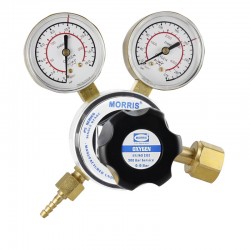
Reduce oxygen valve, Morris
Gas - Oxygen, Outlet Port - 1/4", Inlet Port - W21.8x1/14"
Inlet/outlet pressure (bar): 200/10
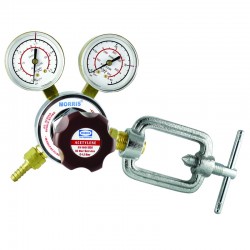
Reduce ventil acetylene, Morris
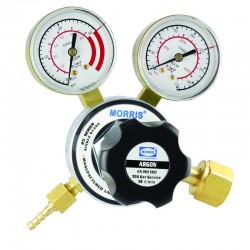
Reduce Air/Co2 fan, Morris
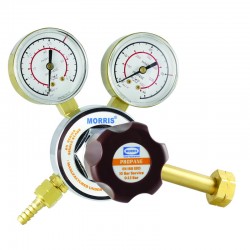
Reduce ventil propan-butan, Morris
Gas - Propane-butane, Inlet port - W21.8x1/14", Outlet port - 3/8" lh
Inlet/outlet pressure (bar): 30/3.5
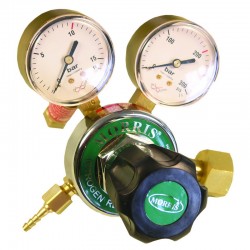
Reduce valve nitrous, Morris